

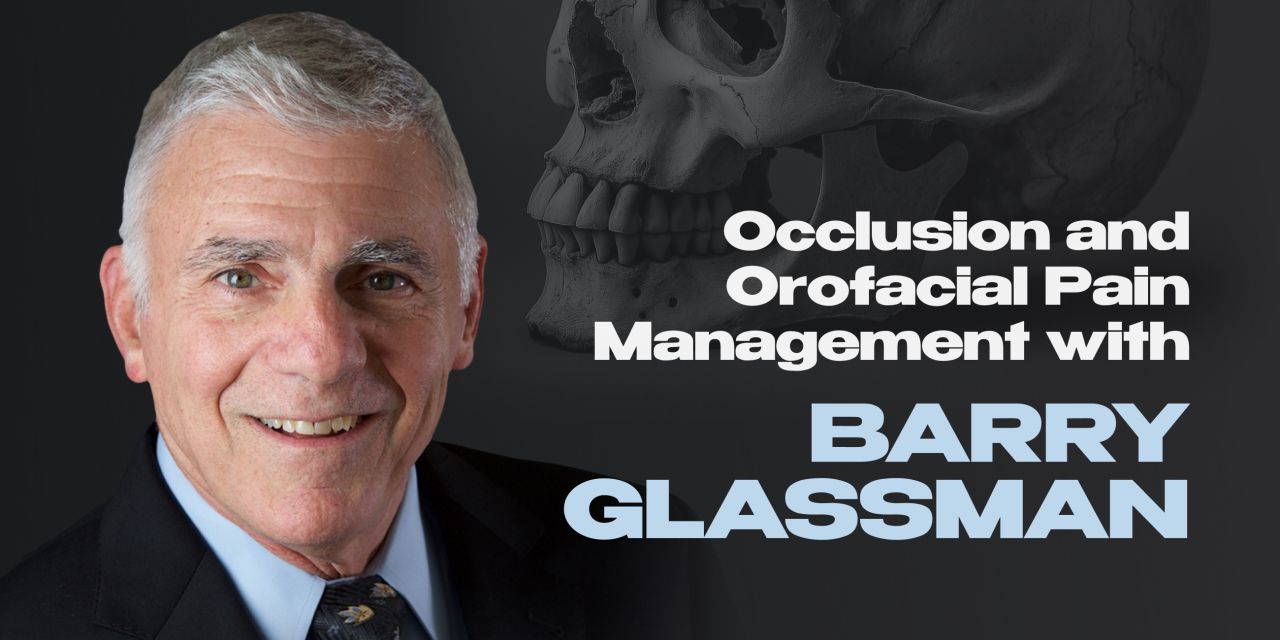
Occlusion and Orofacial Pain Management with Barry Glassman. Evidence-Based Approach and 30+ Years of Clinical Experience
To teach dentists an evidence-based approach to the management of occlusion and orofacial pain.

Occlusion and Orofacial Pain Management with Barry Glassman. Evidence-Based Approach and 30+ Years of Clinical Experience
Barry GlassmanIl corso include le seguenti lezioni:
Ottieni l'accesso a questo corso e a oltre 2 700 ore di formazione con Premium.
Cosa è incluso in
Questo corso online
Dettagli
7 lezioni + 1 gratis (7o 32m)
Certificato Internazionale OHI-S
5.25 CE Credits

Inglese
Accesso alla registrazione durante il periodo di Premium
Descrizione
An evidence-based practical approach to the treatment of orofacial pain, joint dysfunction, and headaches for specialists and general dentists!
This course will provide you with a comprehensive understanding of TMJ dysfunctions, orofacial pain, and occlusion, all based on the renowned concepts of Barry Glassman.
During the course, you will learn in detail about:
– Occlusion, function, and parafunction
– Pain evaluation and establishment of the correct diagnosis
– Evidence-based management of temporomandibular disorders
– Evidence-based management of orofacial pain, including trigeminal mediated disorders (TMD)
– Application of the anterior midpoint stop appliance concept.
Lezione 1.Introduction to Evidence Based Orofacial Pain
– Model change and the attempt to diagnose and manage orogacial pain, headaches, and joint dysfunction
– History of empirical evidence and observations that support structulism
– The role of confirmation bias in the continuation of support of structurlism
– The concept of evidence-based densitry
– Key role of evidence-based dentistyr in orofaical pain speciality.
Recommended for: Orthodontists, Prosthodontists, Functional dentists, Restorative dentist, General dentists.
Lezione 2.Occlusion, Function, and Parafunction
– The principles of occlusion
– Addressing the myths of occlusion
– Practical anatomy
– The role of parafunction
– Centrally mediated bruxism
– Proposed theory on the “purpose of nocturnal bruxism”
– Orthodontics and TMD
– The use of appliance therapy for attenuated trigeminal signaling
– Decreased trigeminal signaling in parafunction.
Recommended for: Orthodontists, Prosthodontists, Functional dentists, Restorative dentist, General dentists.
Lezione 3.Muscle Hyperactivity and Joint Position
– Joint position
– EMG and headache
– Interference and hyperactivity of the lateral pterygoid muscle
– Diagnostically driven therapy
– Trigeminally mediated disorders (TMD).
Recommended for: Orthodontists, Prosthodontists, Functional dentists, Restorative dentist, General dentists.
Lezione 4.Practical Anatomy and Physiology
– Structures of the craniomandibular system
– The ginglymoarthrodial synovial joint
– Joint functional anatomy
– The synovial fluid of the joint
– Interrelated structures of the craniomandibular system
– Control of parafunction.
Recommended for: Orthodontists, Prosthodontists, Functional dentists, Restorative dentist, General dentists.
Lezione 5.Functional and Parafunctional Dynamics in Dentistry
– The role of EMG in evaluating forces vs. the use of resting EMGs
– When occlusion matters: Function vs. Parafunction
– Evaluation of muscle activity in parafunction
– Application of full-arch splints with posterior contact
– Protocols for diagnosing migraines.
Recommended for: Orthodontists, Prosthodontists, Functional dentists, Restorative dentist, General dentists.
Lezione 6.Occlusal Dysesthesia: From Simple Occlusal Adjustment to Treating Occlusal Neurotic
– An in-depth study of the causes of occlusal dysesthesia
– Joint position and centric relation
– Occlusion and occluding
– Restorative dentistry and occlusion
– Electromyography (EMG) during mastication and swallowing
– Electromyography (EMG) during parafunctional clenching
– Analysis of signaling associated with EMG
– Treatment protocols for occlusal dysesthesia
– Key role of parafunction control.
Recommended for: Orthodontists, Prosthodontists, Functional dentists, Restorative dentist, General dentists.
Lezione 7.Managing Occlusal Stability and Parafunction in Clinical Practice
– Treatment of internal derangement
– Principles of nocturnal parafunction control
– Posterior support for occlusal stability
– Treatment approach to malocclusion, including anterior open bite.
Recommended for: Orthodontists, Prosthodontists, Functional dentists, Restorative dentist, General dentists.
Lezione 8.Anterior Midpoint Stop Appliance Concept and Evidence-Based Orofacial Pain Management
– Posterior support myths and management of parafunction
– Protocols for the application of the anterior midpoint stop appliance concept
– Midpoint stop appliance to attenuate trigeminal signaling and alter force vectors
– Potential appliance therapeutic protocol
– Full-arch splint with posterior contact
– Protocols for enthesis and ganglion injections as supportive therapy
– Analysis of clinical cases.
Recommended for: Orthodontists, Prosthodontists, Functional dentists, Restorative dentist, General dentists.
Il corso include le seguenti lezioni: